Quick answer
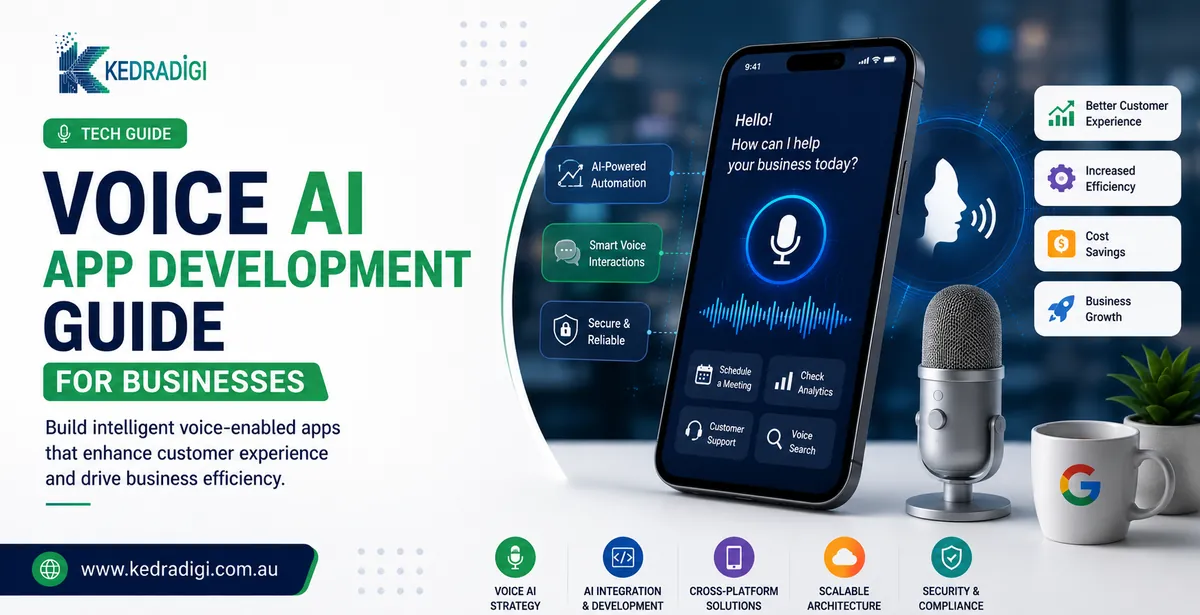
Voice AI combines speech-to-text, a language model that works out meaning and next steps, and text-to-speech that replies naturally. It suits phone agents, hands-free apps and voice search, but needs careful testing for accents, noise and privacy.
Key takeaways
- Voice AI combines speech recognition, a language model and natural-sounding speech.
- It works best where hands or eyes are busy, or where customers prefer to talk.
- Accents, background noise and privacy need careful planning, especially in Australia.
- Always give users a fallback to text or a human.
What are the practical use cases?
- AI phone agents that answer calls and book appointments after hours.
- Hands-free apps for tradespeople, drivers and clinicians.
- Voice search inside apps.
- Accessibility for people with vision or mobility impairments.
- Voice notes turned into structured job reports.
Which features should you plan?
| Feature | What to consider |
|---|---|
| Accent handling | Test with Australian accents and your customers' languages |
| Noise tolerance | Test outside a quiet office |
| Interruptions | Let users cut in, like a normal conversation |
| Actions | Connect to calendars, CRMs and order systems |
| Fallback | Offer text input or a person |
What about privacy and consent?
Voice recordings are personal information. Tell people when they are speaking with an AI, explain if calls are recorded and keep audio only as long as needed.
Call recording has state-based consent rules in Australia, so get advice first. This is general information only.
How do you design natural conversations?
- Greet people and say what the assistant can help with.
- Ask one question at a time.
- Confirm important details, such as dates, before acting.
- Avoid long lists, since people cannot scan audio.
- Make it easy to repeat or reach a person.
How do you measure success?
- Task completion rate.
- Containment: calls handled without a person, with customers satisfied.
- Recognition accuracy.
- Transfer quality: handovers include the right details.
Review failed transcripts each week to see which words and accents need work.
How should you plan the project?
- Choose one use case, such as after-hours bookings.
- Map the conversation and systems it needs.
- Test with real users and background noise.
- Launch to a small group and refine.
Our AI development team can help you plan a sensible first version.
Bottom line
Voice AI works best where people prefer to talk or have busy hands. Plan for accents, noise and privacy, and always offer a way to reach a person.