ERP Software Development Guide
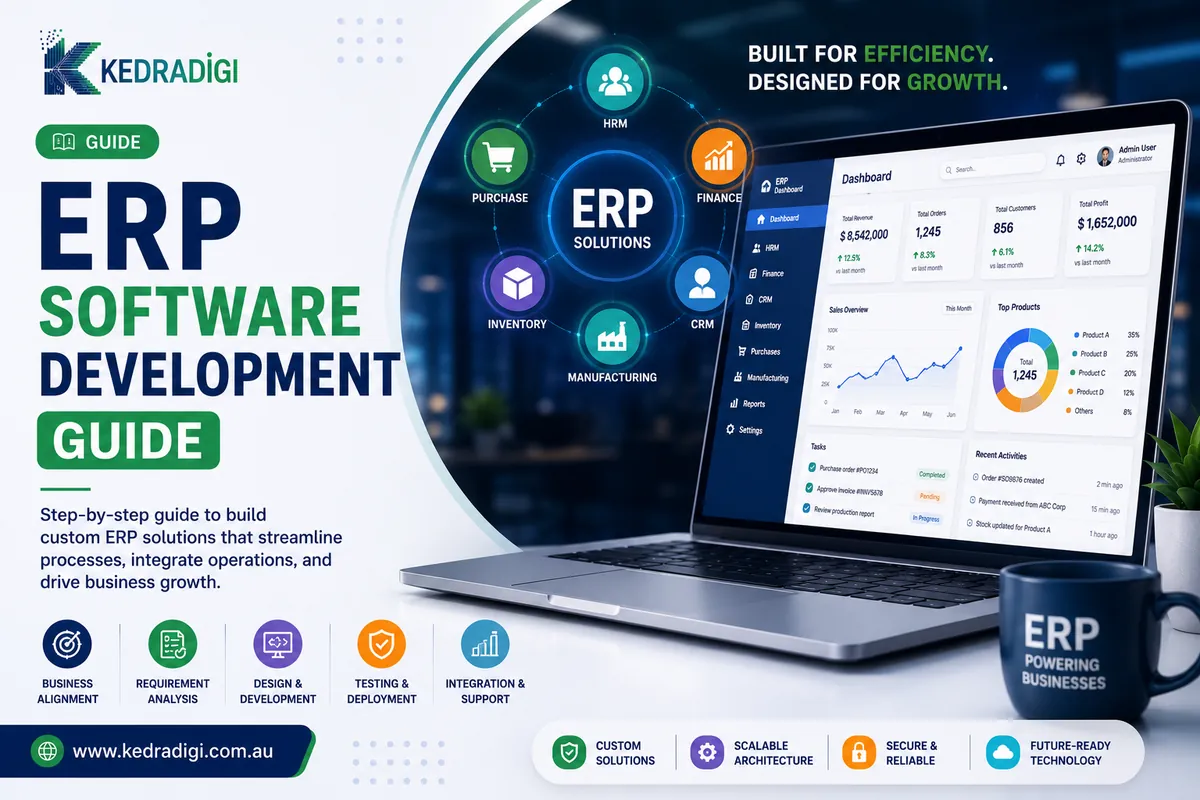
Managing multiple business operations through disconnected systems often leads to delays, duplicate work, and poor decision-making. An ERP Software Development Guide helps businesses understand how Enterprise Resource Planning (ERP) software integrates finance, inventory, HR, sales, procurement, and operations into one central platform.
Unlike generic ERP solutions, custom ERP software is designed around your business processes, making it easier to automate workflows, improve collaboration, and scale operations. Following an ERP Software Development Guide enables organisations to build intelligent software that supports long-term business growth.
What Is ERP Software?
ERP (Enterprise Resource Planning) software is an integrated business management system that connects multiple departments through a single platform.
A modern ERP solution allows businesses to:
- Manage daily operations
- Track inventory
- Monitor finances
- Automate workflows
- Improve reporting
- Increase productivity
Instead of using multiple disconnected applications, ERP centralises business data for better visibility and decision-making.
Why Businesses Invest in ERP Software
Following an ERP Software Development Guide helps organisations replace manual processes with intelligent automation.
Major benefits include:
- Improved operational efficiency
- Better collaboration between departments
- Reduced manual errors
- Real-time reporting
- Faster business decisions
- Increased productivity
- Better scalability
ERP software becomes the backbone of digital business operations.
Essential ERP Modules
Financial Management
Track revenue, expenses, invoices, taxation, budgeting, and financial reporting from one system.
Inventory Management
Monitor stock levels, warehouse operations, purchasing, and product movement through efficient Inventory Management.
Human Resource Management
Manage employee records, attendance, payroll, recruitment, and performance using integrated Human Resource Management tools.
Sales and CRM
Track leads, quotations, sales orders, customer interactions, and after-sales support within one platform.
Supply Chain Management
Improve procurement, logistics, supplier relationships, and warehouse operations through Supply Chain Management.
Reporting and Analytics
Generate real-time business insights using dashboards and performance reports.
Industries Using ERP Software
An ERP Software Development Guide benefits businesses across many industries:
- Manufacturing
- Healthcare
- Retail
- Construction
- Logistics
- Education
- Hospitality
- Wholesale
- Professional Services
- Distribution
Every organisation managing multiple business functions can benefit from ERP software.
Best Practices for ERP Software Development
To maximise the value of your ERP Software Development Guide, follow these best practices:
Understand Business Processes
Document existing workflows before developing the ERP system.
Choose Modular Architecture
Build independent modules that can be expanded as the business grows.
Prioritise User Experience
Simple interfaces improve employee adoption and productivity.
Implement Cloud ERP
Modern Cloud ERP systems provide better accessibility, scalability, and reduced infrastructure costs.
Secure Business Data
Protect financial, employee, and customer information using encryption, backups, and access controls.
Integrate Existing Systems
Use API Integration to connect ERP software with CRM, accounting systems, websites, and third-party business applications.
Future Trends in ERP Development
ERP software continues to evolve with emerging technologies.
Key trends include:
- AI-powered ERP
- Predictive analytics
- Business Automation
- Cloud ERP
- IoT integration
- Real-time dashboards
- Intelligent workflow automation
- Digital Transformation initiatives
These technologies help businesses make faster and more informed decisions.
Frequently Asked Questions
What is ERP software?
ERP software integrates business operations such as finance, inventory, HR, sales, and procurement into one platform.
Who needs ERP software?
Manufacturers, retailers, healthcare providers, logistics companies, educational institutions, and growing businesses.
What are the benefits of ERP software?
ERP improves productivity, reduces manual work, enhances reporting, and streamlines operations.
Is Cloud ERP better than traditional ERP?
For many businesses, Cloud ERP offers greater flexibility, lower maintenance, and easier scalability.
Can ERP integrate with CRM systems?
Yes. Modern ERP platforms support API Integration with CRM, accounting, eCommerce, and HR systems.
Is ERP suitable for small businesses?
Yes. Custom ERP solutions can be designed for startups, SMEs, and large enterprises.
How long does ERP development take?
The timeline depends on business size, required modules, integrations, and project complexity.
Conclusion
Following an ERP Software Development Guide helps businesses build a centralised platform that improves efficiency, simplifies operations, and supports long-term growth. By integrating Inventory Management, Human Resource Management, Financial Management, Supply Chain Management, Cloud ERP, API Integration, and Business Automation, organisations can streamline workflows and make smarter business decisions.
As businesses continue their Digital Transformation, investing in custom ERP software provides greater operational visibility, improved collaboration, and the flexibility needed to scale in an increasingly competitive market.